


How to Prepare for an Interview: An HR Manager’s Step-by-Step Guide

Although I wouldn’t call myself an interview expert, I have conducted and participated in enough interviews to confidently say I’ve seen it all. The good, the bad, and the painfully mediocre.
Landing an interview is exciting, but it can also be nerve-wracking. Over the course of my career, I’ve developed a repeatable interview prep routine that helps calm my nerves, puts me in the right headspace, and ultimately helps me perform well.
As an HR Manager, here is exactly how I prepare for and ace my interviews.
1. Create an Application Tracker
As soon as I know I’m actively job hunting, I create an application tracker. I usually skip this step for one-off applications, like when I’m happy in my current role but come across an opportunity I can’t ignore.
Your tracker can live in Excel, Google Sheets, Notion, or OneNote. I personally use OneNote.
Create a table with the following columns:
- Role – the title you applied for
- Company – the organization name
- Industry – the company’s primary industry
- Salary – the posted or expected salary range
- Status – use a drop-down with: applied, interviewing, rejected, declined, accepted, ghosted
- Notes – space for interview details or follow-ups
- Job Posting – a saved PDF of the posting (not just the link)
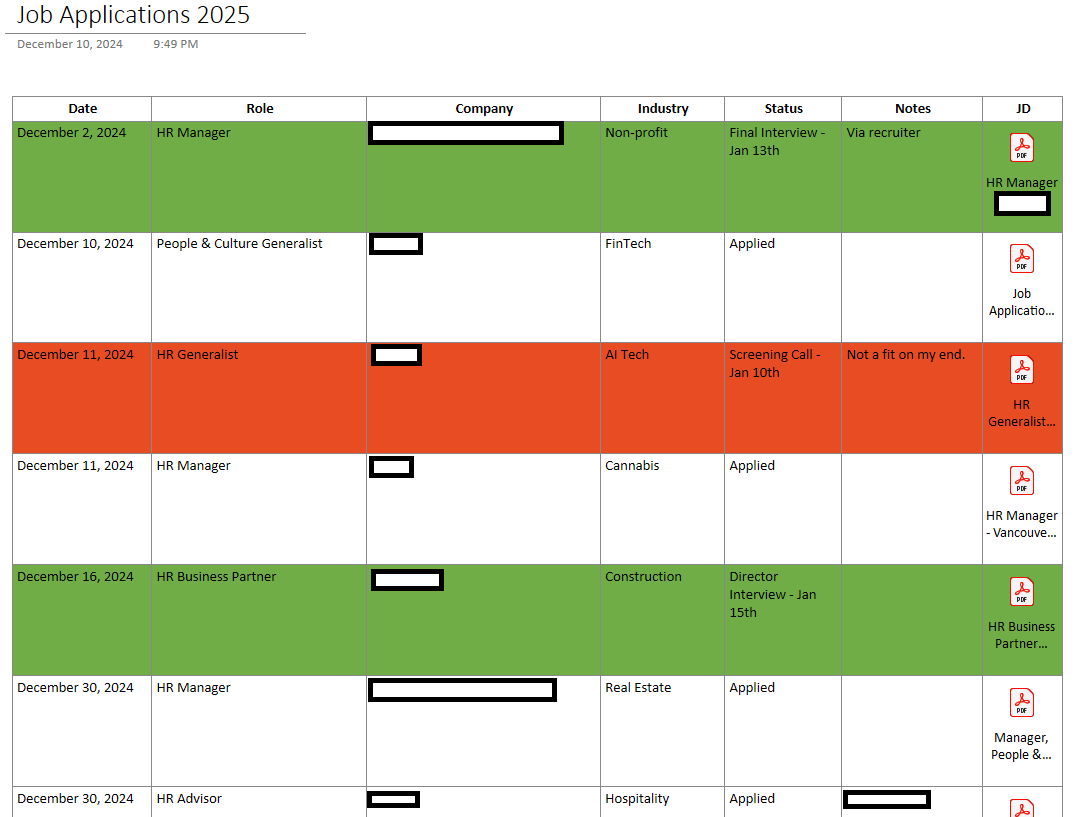
I never used to track my applications until I tried it once, and it was a total game-changer. Not only does it keep everything organized, but it also motivates me to keep applying and helps me stay aligned with what I want in my next role, whether that’s a higher salary, a new title, or a different industry.
If you’re using Excel or Google Sheets, I recommend adding conditional formatting. I use green for applied, yellow for interviewing, and red for rejected or ghosted applications.
2. Review the Job Description (Three Days Before)
You got the interview invite. Congratulations!
About three days before the interview, I begin my prep by reviewing the job description. This is where saving the posting as a PDF becomes incredibly useful. Job postings can be taken down when they’ve narrowed down their shortlisted candidates.
When reviewing the job description, focus on:
- The organization’s mission and background
- What excites you about the company and its industry
- The key responsibilities and required experience
- How your experience aligns with each responsibility
- Desired skills and competencies
- The company culture and values
Make notes as you go. Tie everything back to your own experience so you’re ready to speak confidently and specifically.
3. Create a List of 10–15 Questions You May Be Asked
If you’ve interviewed before, you probably already know the most common questions for your role. If not, search “interview questions for [your role]” or use ChatGPT to generate a list.
Choose 10 to 15 questions and draft answers for each.
Common screening interview questions include:
- Tell me about yourself
- Why are you looking to leave your current role?
- Why are you interested in this company?
- What’s a recent challenge you’ve overcome?
- How do you handle conflict at work?
Common HR interview questions I frequently see include:
- Describe a time you resolved a conflict between a manager and their direct report
- What policies have you successfully implemented?
- How do you keep employees engaged?
- Describe a difficult situation you’ve navigated
- What makes you the ideal candidate for this role?
4. Draft Bullet-Point Answers Using the STAR Method
When preparing your answers, keep them in bullet-point format. Interviewers can tell when answers are overly rehearsed, and memorized scripts rarely sound natural.
For behavioural or scenario-based questions, I like to prepare two or three different examples, so I don’t repeat the same story multiple times.
Use the STAR method to structure your responses:
- Situation – What was happening?
- Task – What was your responsibility?
- Action – What did you do?
- Result – What was the outcome?
Example:
Question: Describe a time you managed competing priorities under a tight deadline.
- Situation: During a busy period, I supported multiple teams while preparing time-sensitive reports for leadership.
- Task: I needed to meet all deadlines without sacrificing accuracy or service quality.
- Action: I prioritized tasks by urgency, communicated realistic timelines, broke large reports into smaller tasks, blocked focused time in my calendar, and delegated where possible.
- Result: All deliverables were completed on time, leadership received the reports as scheduled, and teams appreciated the clear communication.
5. Prepare Questions for the Interviewer
When the interviewer asks if you have any questions, never skip this part. As an interviewer, I can confidently say that candidates who don’t ask questions often come across as less engaged or less interested.


I usually prepare six to eight questions. This helps me learn more about the role while also showing genuine interest.
My top three go-to questions are:
- What challenges is the company currently facing, and how does this role support addressing them?
- When was the last time leadership acted on employee feedback?
- What does the next couple of years look like for the company?
A great question can make you memorable!
6. Practice (But Don’t Overprepare)
Practice matters. A lot.
Rehearse your 30-second introduction and your answers to common questions. I used to wing interviews and learned the hard way that confidence without preparation doesn’t work.
That said, overpreparing can be just as damaging. Candidates who sound overly scripted often struggle when asked an unexpected question and can appear rigid or inauthentic.
To practice, I mentally walk through my answers, then say them out loud. I repeat this process about three times, or until I can speak smoothly without fumbling. You can practice alone, in front of a mirror, or with a friend.
7. Update Your Tracker After the Interview
Once the interview is done, update your tracker. Add notes about how it went and when you can expect a response. This makes it easier to decide if and when to follow up.
And if you don’t get the job, that’s okay! Every interview is valuable practice, and each one brings you closer to the right opportunity.
How do you prepare for interviews? I’d love to hear what works for you.

Love these tips, Claire – I recently had an interview and did all of these, so it’s good to know that’s how you prepare too!